
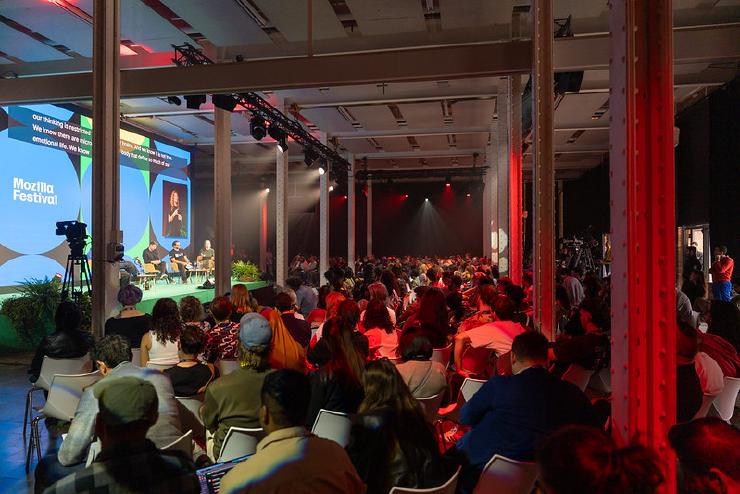
Conferences and festivals love a theme. It gives us something to rally around and a common thread connecting our conversations and experiences. This year’s MozFest theme was “Wilding”, a word that hints at the sins of extractivist technologies while leaving plenty of room for interpretation.
As Superbloom Design’s in-house participation strategist and Program Manager for Coaching & Community, I found myself thinking about what Wilding might mean for my work supporting people building public-interest technology.
Making room
MozFest is busy. Events, pre-events, post-events, side events, hangouts, and meetings fill your schedule, with no shortage of things to do or people to meet.
As a mother of a young child, I don’t often travel alone for work, so I wanted to make the most of this trip. I decided to go beyond the official program and make room for unexpected conversations and encounters. As it often turns out, those moments were some of the most valuable.
One came at a side event hosted by the Civic Tech Field Guide, a longstanding archive of civic and public-interest technology. The room brought together people who remembered a time when “new technologies” were widely seen as tools for liberation and democratic change.
Daniel Mackisack, who now leads the initiative, recalled being in Cairo during the so-called Arab Spring. People didn’t need social media to know others opposed the regime, he observed. They could simply look out of their windows and see it for themselves.
Yet the Arab Spring became a funding myth about technology’s power to bring about democracy. We gave technology disproportionate credit for political change that was ultimately driven by people. And perhaps that is something we’re still too quick to forget in pursuit of the next spectacular solution.
Product-community fit
Another highlight was the Mozilla Foundation Incubator Showcase, where four of the 10 grantees Superbloom supports through its coaching program presented their projects.
Opening the showcase, Mozilla Foundation CEO Nabiha Syed, in conversation with Anil Dash of AntiTech, spoke about the human side of technology and what she called “product-community fit”.
She reflected on how people are beginning to understand what’s at stake and ask more fundamental questions: Is this technology worthy of our time and attention? And how do we make sure we’re building technology that actually serves us?
Doubt is growing, and understandably so. But doubt alone doesn’t tell us what to build instead.
Product-community fit goes beyond understanding a product’s users. Communities are made up of relationships: between people, institutions, the infrastructure and funding they depend on, and the land, energy and resources that technology draws on. A product needs to make sense within those relationships, too.
That means paying attention to the people already trying to bring about change: activists, organizers and others working towards more just and sustainable futures. And it means understanding what they need to succeed, rather than assuming we already know.
This is where Superbloom’s work comes in.
Our coaching program connects public-interest technology teams with experienced practitioners who help them navigate challenges that funding alone can’t solve.
A good idea, a working product and sufficient funding all matter. But none guarantees that something will be useful to people.
Collectives, a project supported by Germany’s Prototype Fund, offers a good example of this.
The project began as a dashboard for left spaces using Nextcloud to organize. Early in its first funding round, the team was introduced to Nextcloud’s core team. It turned out both were planning a dashboard.
Rather than duplicate the work, the Collectives team changed direction. Nextcloud continued developing its dashboard, while Collectives focused on a wiki tool that became the Nextcloud Collectives app.
Maybe that’s what product-community fit means: understanding where a project belongs, who it serves and when to change direction. Through conversations with others working on similar problems, the Collectives team found a place for its work within something bigger, reaching users beyond those originally imagined.
Sometimes the most useful thing you can do is bring the right people together.
What learning takes
But our coaching program does something else, too. It connects people with experience to share with those who could use it, giving them space to ask questions, exchange ideas, and work through problems together.
At lunch during MozFest, I had a conversation about the difference between handing someone a list of resource links and actually helping them learn.
Learning is embodied, relational and contextual. It doesn’t happen simply by giving people access to resources, recordings, toolkits or standardized training programs.
It also takes reflection. When you’re busy delivering a project, it’s easy to keep moving without questioning whether you’re still heading in the right direction. In the Cynefin framework, sensing is part of responding to complexity: paying attention to what’s happening, learning from it and adjusting as you go.
And sometimes learning means realizing that the direction you originally chose isn’t the right one. That’s not necessarily a failure, as it can mean you’ve learned enough to make a better decision.
Which brings me back to Wilding.
In ecology, rewilding means restoring the conditions that let ecosystems recover and thrive, rather than trying to control every outcome. I think there’s something useful in that idea for our field. It also fits our name. A superbloom happens when the right conditions come together and an entire landscape bursts into flower.
Maybe our work isn’t always about coming up with something new. Sometimes it’s about making room for what we can’t fully plan: relationships, curiosity, collective learning and unexpected possibilities.
A colleague recently told me it’s worth revisiting old conversations if the questions are still relevant. Not every idea needs to be new to be useful.
That’s what I’m taking away from MozFest.
We spend a lot of time talking about what technology can do, and less time thinking about the people who build it, use it, question it and help others make sense of it.
Creating the conditions for those people to succeed shouldn’t be a radical idea. But when technology moves faster than our ability to understand its consequences, perhaps it’s more important than ever.
Maybe nurturing teams to reframe or improve existing solutions is the wildest thing we can do.
Superbloom provides coaching support to grantees of the Prototype Fund, Mozilla Foundation Incubator, and Interledger Foundation. If you are interested in learning more about this, please email Alicja at [email protected]